Posted by Brett on July 25th, 2013. Tagged: Becks | Comments are
off for this post
As I’ve said before, I think most people would probably subscribe to the idea that how much you choose to invest in someone, or something, is personal to you; it’s a reflection of the morals and ethics by which you live your life. Perhaps you don’t have much time for Luis Suarez because you have a natural aversion to unapologetic racism. Equally, you might struggle to feel a kinship with Jose Mourinho because you prefer those you idolise to show a certain amount of humility. Or maybe you don’t like Gareth Bale because he does that heart thing with his hands when he scores and you don’t believe in love. Then there are those who present a paradox. For me, that paradox is David Beckham.
I decided almost immediately, at first sight, that David Beckham was out of place at United. He was riding on the coat-tails of others coming through at the time, hiding his unnatural, awkward playing style – which was littered with the embarrassing affectations that were sneaking in to the game – and getting away with someone else’s career. However, it didn’t take long for me to note his infectious enthusiasm and, aided by his knack of scoring decent looking goals, my opinion thawed fairly rapidly (what can I say? I’m fickle). It’s hard to admit when you’re wrong though and it wasn’t until he became a hate figure, after the World Cup in ’98 (told you I was fickle), that I came out as a proper Beckham fan, which isn’t to say it’s been easy (even as I’m writing, my walk to work has been spoiled by a ten-foot Beckham, grinning hokily in the new advert for Sky).
I project that newer fans (those who started following football towards the end of the nineties) are more likely to get on-board with Beckham than those who were around earlier, as they’re more comfortable with how things are in football now. The game has changed: a change that Beckham, without a doubt, has been seen (and used) as a strong motif of (and for). However, I think it’s important when talking about specific players, and their acceptance of the inevitable extra-curricular monetary rewards, that we debunk the myth that the majority of other footballers all make ethically led decisions with regards to how they’re marketed, how they’re exploited, and how they welcome that exploitation. The likes of Best, Charlton, Cantona, Zidane, Pele, Maradonna, Messi, even Scholesy, have all “sold out”, which isn’t to say it makes it right.
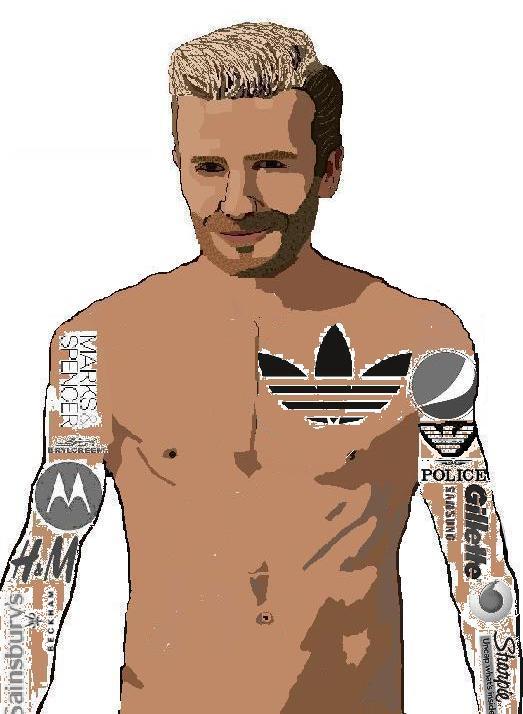
It’s also important – if we purport to be “against modern football” – to take our share of the responsibility. We’re sold the myth that capitalism is consumer led, and whilst that may once have had a grain of truth in it; it’s now definitely a lie. It is, however, hard to argue against consumers being complicit in driving consumerism forward. So, before we bemoan the likes of Beckham for conspiring to ensure we’re all lusting after cans of carbonated death, shouldn’t we be throwing down our Sharpies and taking a good look at ourselves, the reflexive impotent? Is it that simple? The simple answer is, ‘yes’ and ‘no’, which isn’t to say it makes it right.
As a supplementary point: it’s also impossible, when moralising, to allow each individual the unique circumstances that their life inhabits and the experiences engendered through such circumstances. We can’t possibly expect to interpret accurately why an individual – whom we barely know – behaves the way they do via a catchall judgement. Though that’s not to say it doesn’t make us feel better about ourselves.
What’s different about David Beckham’s ‘fame’ (why he’s so prominent and also why he’s so vilified), I think, is that his arrival as an “idol” was inextricably intertwined with the arrival of the modern celebrity, bursting out at us from the tabloid domain, replacing the real news as the new real reality news. Lifestyle magazines – in all their guises – mostly, if not all, funded by parties with more than a passing interest in where and why the readership parted with their hard-earned; corrupting and co-opting subjective opinions, to suit editorial, in order to help create collective, constructed ‘objective’ ones which their readership could in turn share and spread, which in turn has given rise to the situation in which we find ourselves now: a new age of narcissism. Much of David Beckham’s monetary value rests in the part of his footballing anatomy he has probably used the least: the twenty-five centimetres or so above his neck. It provides his family with everything they could possibly want, and the things they can’t possibly want, must-have belongings; the things that currently, it would seem, provide status and meaning. Again, that’s not to say it’s right.
There are other points I’d like crowbar in before I’m in danger of breaking my 1400 maximum word-limit rule: the way he scowls and pouts on and off the pitch with the precision of a person who has spent more than enough time rehearsing scowls and pouts on and off the pitch in front of any available reflective surface, a bathroom mirror, a shop window, or a teaspoon, coupled with, what from the outside appears to be an apparent courting of attention, is crude to some of us. But then, the culture of the tabloid press to build ‘em-up-to-knock-‘em-down, along with the misogyny with which the media treats Victoria because she periodically declines their invitation to take part in their recreational sexism, is hardly for the weak. To remain open and demonstrative in the face of all that takes a strength of character – from both Victoria and David, whatever their motivation may be – that I’m not sure I have. The way all of the above impacts on the way his footballing ability is judged, is definitely unfair.
While still playing, his enthusiasm for the game, his will to win, his work ethic, were at times incredible, matched by very few players I’ve watched. Sometimes his own idea of himself got the better of him (you all saw the Greece game right?) but again, whatever his motivation, it’s hard – I think – to deny he was an inspirational, positive force for good on the pitch and it’s also unfair to suggest he was nothing more.
There have been few sights on a football pitch that have regularly brought me more pleasure than the gentle waft, or mighty thrust, of that right foot. No player with the ball at his feet on the touchline has had me lunging forward in anticipation like Beckham. If I was asked to build my ultimate footballer – because it’s only a matter of time – Beckham’s right foot would be the first extremity on the design sheet (the left one, not so much).
He could create, he could score, deceive and disappoint. He brought elegance, excellence, petulance and arrogance. In short, he brought drama however it was dressed up. And he could do that acknowledging the crowd by putting your hands repeatedly together over your head thing – the silent showy clappy thing – as you walk off the pitch, really, really well. All the things that entertain, amuse, infuriate, leave us aghast or crying into our pot-noodles. All the things … all the things that make football, football – well, a lot of them, let’s not get carried away.
Yes, he happens to have a sufficiently inoffensive, symmetrical, healthy face and body, not too unobtainable to appear unobtainable so you didn’t spend money, yet not too obtainable to appear obtainable without spending money. And yes, his charm and modesty mean the products he’s charged with pushing in his obtainable/unobtainable way make their way onto shelves in homes the world over, before the smile has even settled on those stubbled dimples. He’s the devil – there is no question. But if Beckham the footballer were the paradigm from which new footballers were created, I think we could be happy with our lot.